Flux.3 Image Klein Is Out: Specs, Pricing and Access

The short answer
Black Forest Labs released FLUX 3 Image Klein on November 3, 2026, a 5.6B parameter open weights model for text-to-image, image editing and multi-reference generation with up to 10 images. It supports native 4K output and bounding boxes, and the API costs $0.008 to $0.036 per image. Weights are on Hugging Face under the FLUX Kommunity License, and the model runs in ComfyUI and Diffusers.
On this page (12 sections)
What is FLUX 3 Image Klein?
FLUX 3 Image Klein is a 5.6B parameter open weights image model from Black Forest Labs for text-to-image generation, image editing and multi-reference generation. It shares core capabilities with the full FLUX 3 Image model, including native 4K generation and bounding boxes. BFL released it on November 3, 2026.
BFL's own account said the same day that the model had reached 1M+ downloads and is "designed for precise editing." A Reddit post from u/MonkeyBoyPoop says BFL updated its documentation to clarify that Klein is primarily built for editing. The Hugging Face card describes it the same way.
The release includes a base model for fine-tuning and a step distilled model for low-latency generation. FP8, INT8 and NVFP4 builds were developed with NVIDIA support.
FLUX 3 Image Klein release date and availability
FLUX 3 Image Klein is available now. BFL announced it on November 3, 2026, with weights on Hugging Face, an endpoint in the BFL API, and ready-made ComfyUI workflows and Diffusers support.
The distilled checkpoint is the one served through the BFL API. The base checkpoint is on Hugging Face only. Both repositories are publicly accessible but require you to accept the license conditions before downloading files.
BFL says LoRA training works from day one in Diffusers and Ostris's AI Toolkit, and that NVIDIA's NeMo AutoModel ships recipes for the released checkpoints.
FLUX 3 Image Klein key features and specs
Klein handles editing, text-to-image and multi-reference composition in one model, taking a prompt and up to 10 reference images and returning one image. Output goes up to 4K. Qwen3-VL-4B-Instruct serves as the text encoder.
 Translucent bounding frames placed over a product scene on a gridded layout
The 5.6B figure refers to the image transformer only. The text encoder is separate.
| Spec | Klein (Distilled) | Klein Base |
|---|---|---|
| Parameters | 5.6B | 5.6B |
| Max resolution | Up to 4K | Up to 4K |
| Inference steps | 16 | 50 |
| Guidance | 1 (none in HF table) | 3.5 |
| Bounding boxes | Yes | Yes |
| Best for | Fast generation, self-hosting | Fine-tuning, LoRA, research |
| Availability | API, Hugging Face | Hugging Face |
Bounding boxes sit on a 0 to 1000 grid in the prompt. You can place elements, then recolor, move, replace or remove them. BFL states that boxes guide placement and scale and do not act as a hard pixel mask. Text rendering inside images is also listed as a feature.
The prompt upsampler requirement
BFL repeats one instruction across its docs: always run a prompt upsampler. Klein is trained on full scene captions, and a short prompt sent as typed gives generic output.
BFL offers flux-3-image-klein-pup, which the reference code and ComfyUI workflows run by default. Any LLM with a system prompt that expands the request into one full scene caption also works. The Diffusers pipeline does not call the upsampler itself.
FLUX 3 Image Klein pricing and free access
Through the BFL API, FLUX 3 Image Klein costs $0.008 to $0.036 per image depending on output resolution. Text-to-image and editing are priced the same. The weights are free to download, subject to the FLUX Kommunity License.
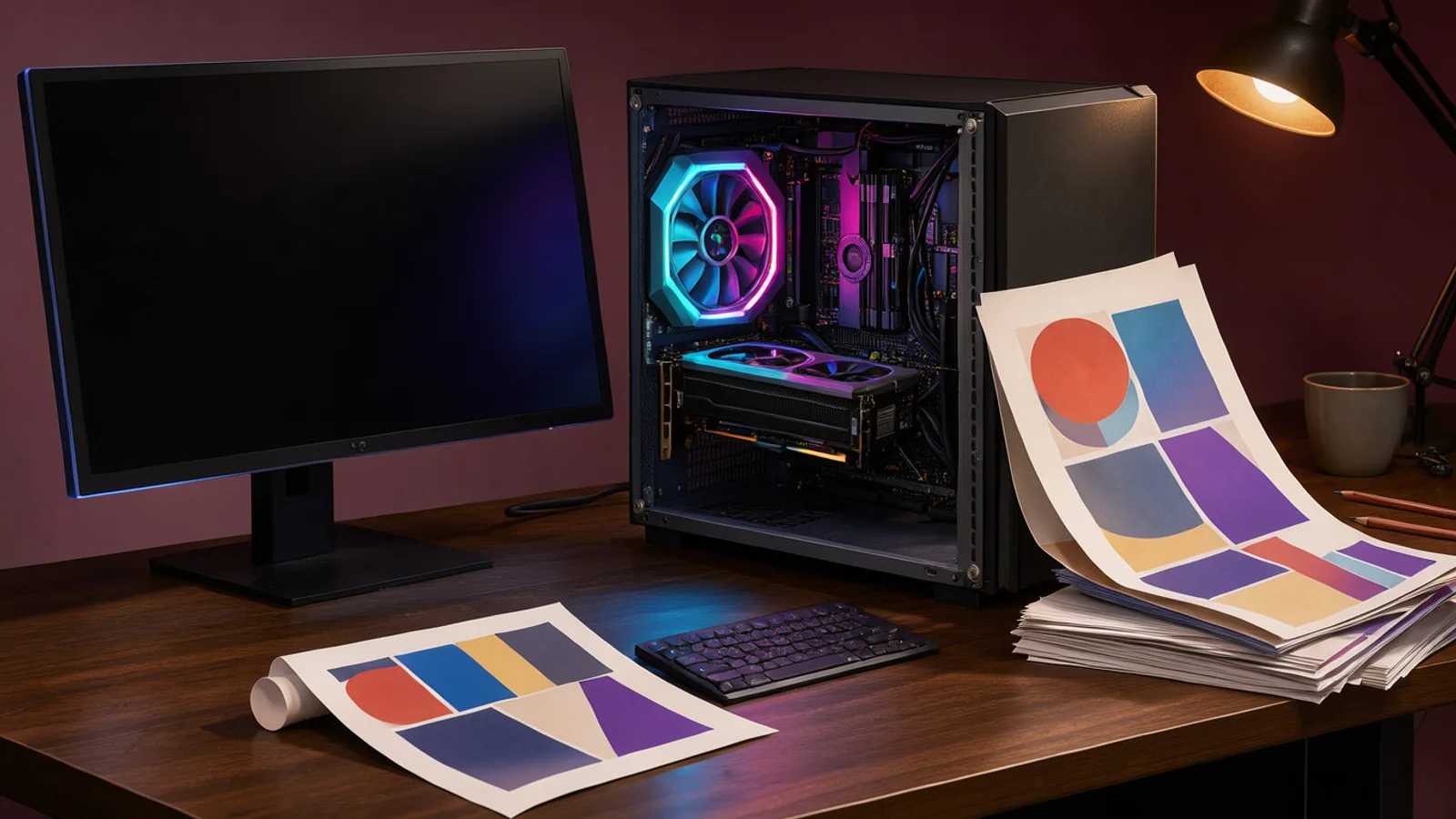 A desktop PC with a graphics card beside printed ad mockups
| Resolution | Price per image |
|---|---|
| 768 x 768 | $0.008 |
| 1K | $0.009 |
| 1.5K | $0.011 |
| 2K | $0.014 |
| 4K | $0.036 |
The license permits non-commercial use and provides a commercial-output exception for Qualifying Users, subject to its terms. BFL's materials do not spell out who qualifies in the text available here, so check LICENSE.md before using self-hosted outputs in paid campaigns.
Can you run FLUX 3 Image Klein locally?
Yes. BFL says the generator weights need 11.2 GB in BF16 and 5.6 GB in FP8, and the INT8 build runs on NVIDIA GeForce RTX GPUs with as little as 8GB of VRAM through ComfyUI or Diffusers. The docs also say it fits down to an RTX 3090.
BFL reports that the distilled model with the INT8 build generates a 1MP image in about 4 seconds on an RTX 5090 and under 9 seconds on an RTX 4070 in ComfyUI. NVIDIA measured those figures. Quantized files are smaller than total GPU memory use, so leave headroom for the text encoder and upsampler.
FLUX 3 Image Klein vs competing models
In BFL's internal evaluations, Klein ranks first in text-to-image, multi-reference generation and image editing among the open weights models compared. It also rates above the closed models Ideogram V4.5 and FLUX.2 [pro]. These are the maker's own numbers, not independent benchmarks.
| Model | Parameters | Notes from BFL |
|---|---|---|
| FLUX 3 Image Klein | 5.6B | Ranked first in BFL's evaluations |
| Qwen-Image 2.1 | 7B | Larger, ranked lower |
| Krea 2 | 12.9B | Larger, ranked lower |
| FLUX.2 [klein] 9B | 9B | Klein gains 91 Elo in text-to-image and 70 in editing |
Through the API, BFL says Klein has lower latency than Qwen-Image 2.1, FLUX.2 [pro], Ideogram V4.5 and Krea 2. BFL timed Klein on its own servers and timed the other models from the client, so the latency comparison is not like for like.
How to use FLUX 3 Image Klein for AI video and static ads
For ad teams, Klein's most relevant strengths are editing and multi-reference input. Swapping a background, recoloring a product or moving and replacing elements with bounding boxes are jobs the model is built for, at a low per-image cost.
Practical fits, based on the specs:
- Product variants: feed up to 10 references (product, packaging, scene) and compose one image.
- Static ad resizing and layout tests: use bounding boxes to hold element placement across versions.
- Video start frames: generate or edit a clean first frame at up to 4K before sending it to a video model.
- Brand look: train a LoRA from the base checkpoint.
Teams that want to compare it against other models can try it in the AdGraam AI Playground. For repeatable edit, upscale and video chains, Flow Builder fits. Our guide to making static ads with AI covers the broader workflow.
What to watch next
Three things are open. Independent benchmarks will show whether BFL's internal rankings hold on ad-style prompts. The license terms for commercial output need a careful read. And the prompt upsampler requirement adds a step to any pipeline that skips BFL's default workflows.
BFL also says it works with teams on customizations for lower latency, but has not published details. For another open image model, see our piece on P-H3-Image from Pruna.
What people are posting
FLUX 3 Image Klein is now at 1M+ downloads. It's designed for precise editing. Here's some show and tell 🧵 https://t.co/ODnM9yLjH7
Black Forest Labs updated Flux.3 Image Klein documentation to clarify that its primarily designed for image editing. Link: https://i.redd.it/nehmwdclrdzh1.png
Key takeaways
- FLUX 3 Image Klein is a 5.6B parameter open weights model for text-to-image, editing and multi-reference generation.
- It accepts up to 10 reference images and supports native 4K output and bounding boxes on a 0 to 1000 grid.
- API pricing runs from $0.008 per image at 768 x 768 to $0.036 at 4K, with the same price for generation and editing.
- The distilled model uses 16 steps; the base model uses 50 steps and is meant for fine-tuning and LoRA training.
- With the INT8 build it runs on RTX GPUs with as little as 8GB of VRAM, about 4 seconds per 1MP image on an RTX 5090, according to BFL.
- It ships under the FLUX Kommunity License, which permits non-commercial use with a commercial-output exception for Qualifying Users.
Compare 200+ AI video and image models side by side
Run Kling, Veo, Sora, Seedance, Flux, Ideogram and Recraft in one Playground, or turn any product URL into ready-to-launch ads.
Frequently asked
When was FLUX 3 Image Klein released?
Black Forest Labs announced the release on its blog on November 3, 2026. The same day, the company's X account said the model had passed 1M+ downloads.
How much does FLUX 3 Image Klein cost?
Through the BFL API, it costs $0.008 per image at 768 x 768, $0.009 at 1K, $0.011 at 1.5K, $0.014 at 2K and $0.036 at 4K. Text-to-image and editing cost the same. The weights themselves can be downloaded from Hugging Face.
Can I run FLUX 3 Image Klein locally?
Yes. The generator weights need 11.2 GB in BF16 and 5.6 GB in FP8, and the INT8 build runs on NVIDIA GeForce RTX GPUs with as little as 8GB of VRAM through ComfyUI or Diffusers. BFL's docs also say it fits on consumer GPUs down to an RTX 3090.
Can you use FLUX 3 Image Klein for commercial ads?
The FLUX Kommunity License permits non-commercial use and provides a commercial-output exception for Qualifying Users, subject to its terms. Read the license text before running paid ads from self-hosted outputs.
Do I need a prompt upsampler with FLUX 3 Image Klein?
Yes, according to Black Forest Labs. The model is trained on full scene captions, and a short prompt sent as typed gives generic output. BFL provides its own upsampler, flux-3-image-klein-pup, and says any LLM with a suitable system prompt also works.
Sources
More AI model news & creative guides

Topaz Wonder 4 Is Out: Features, Pricing and Access
Topaz Wonder 4 is live in Topaz for Web and Mobile. See the Mixture of Experts upscale, sharpen and denoise model, API pricing from $0.0428 and plan details.

P-H3-Image: Pruna's Open Image Model From MiniMax H3
Pruna AI open-sourced P-H3-Image, an image generation and editing model built from MiniMax-H3: 8 steps, up to 16 MP, 8-image edits, ComfyUI support.
Hy4 Preview: Tencent Hunyuan Release, Pricing and Access
Tencent Hy4 is teased as coming soon. See the Hy4 preview's Agent Arena ranking, listed pricing, 1,000K context window and what it means for ad teams.
AI UGC Ads: What They Are, What They Cost and How to Make One
AI UGC ads explained for D2C brands: how they compare with creator UGC on cost and speed, which formats work, the disclosure rules and how to make one.
Hook Rate and Hold Rate: Formulas and Benchmarks for Meta Ads
How to calculate hook rate and hold rate for Facebook and Instagram video ads, what good looks like, how to add them to Ads Manager and what to fix when they drop.
How to Make Static Ads With AI: A Guide for D2C Brands
How to make static ads with AI, step by step: the sizes Meta wants, eight formats worth testing, a brief template and the checks to run before you upload.
Your move
See your product as a winning ad
Turn a product URL into static ads and UGC-style videos, rebuild the competitor ads that already work, and read your Meta data to know what to make next.
AdGraam News DeskAI video and image news
The AdGraam News Desk tracks AI image and video model launches, leaks and rumors from labs, leakers and creators, and checks each claim against its sources. Unconfirmed stories say so, and each page is updated as its story develops.