Pika Enact: Real-Time AI Video Direction Preview
The short answer
Pika unveiled Enact on 2026-11-18, a research preview built on Pika H3 Flex that lets users drag actors, give spoken notes and steer the camera while video plays. Pika reports 1.5x to 1.8x real-time generation. It is not public or priced; interested teams are told to email enterprise@pika.art.
On this page (11 sections)
Pika Labs unveiled Enact on 2026-11-18, a research preview that lets a creator direct an AI video scene while it plays. Pika says it is built on Pika H3 Flex and is designed to mimic directing on set. It is not available to the public.
In its own post, Pika called Enact "a research preview of scenes that respond to you" and invited people to reach out for a demo. A creator roundup from @RobotCleopatra also flagged the launch.
What is Pika Enact?
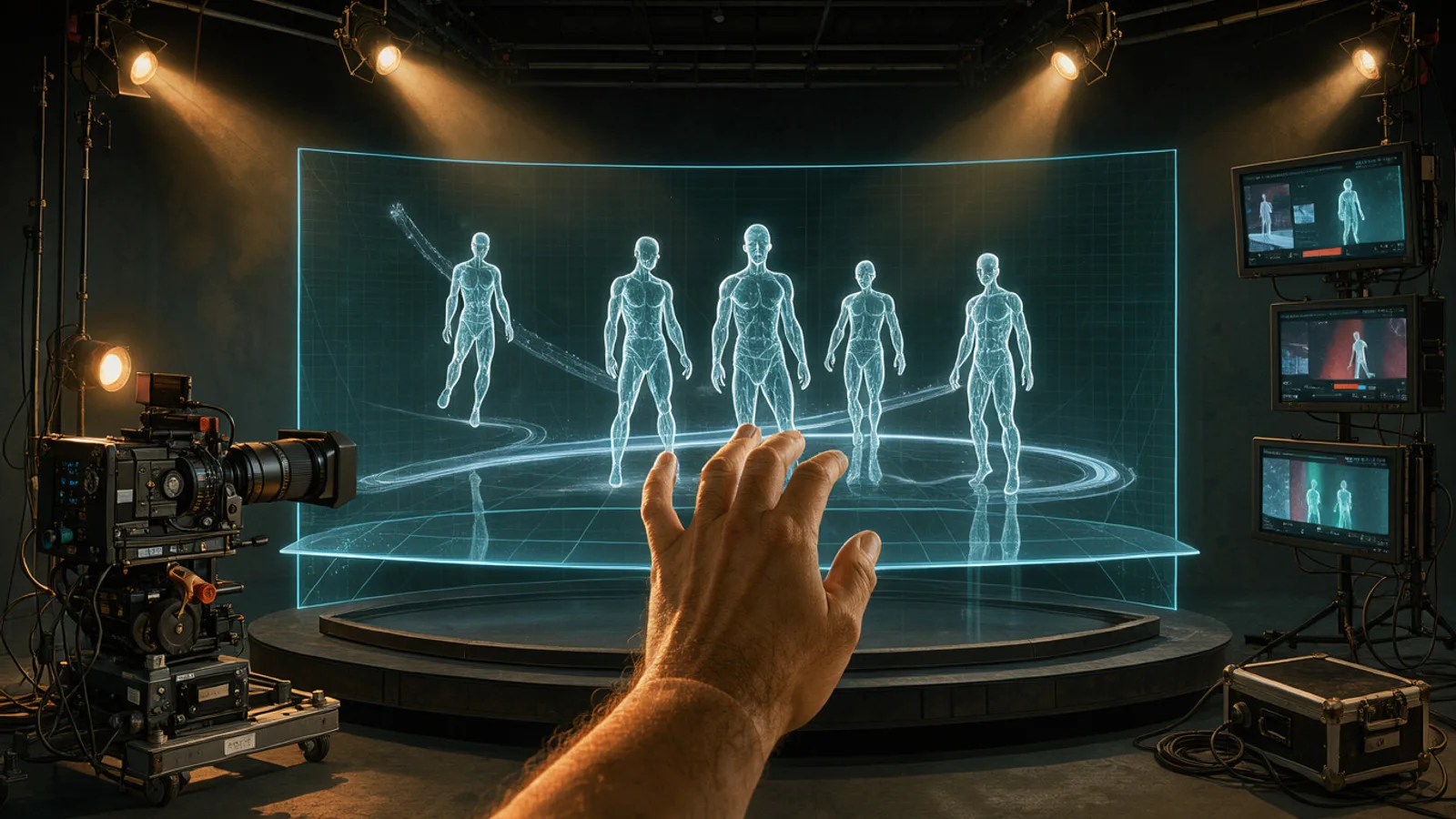
Pika Enact is a research preview from Pika Labs, described as an experimental live-streaming environment built on Pika H3 Flex. It generates video and sound in sub-second chunks, so a user can move actors, give spoken notes and steer the camera without waiting for a full render.
The idea replaces the prompt, render, review and retry loop with continuous control. Pika frames it as the start of a new way of making AI video.
All performance figures come from Pika and have not been independently verified, according to AlphaSignal's write-up.
What are Pika Enact's three directing modes?
Enact has three modes: Live Staging, Live Actor Direction and Live Camera Control. Each covers one layer of a scene: where things are, how actors behave, and how the camera moves.
 Three abstract panels representing staging, actor direction and camera control
- Live Staging: drag a person or object while the video runs. Pika says the model redraws pose, lighting, shadows and the vacated background, with no cutout edges.
- Live Actor Direction: typed or spoken notes such as "move closer to her" or "make it a kitchen at night" guide AI actors, who respond in character with distinct voices and remember earlier notes. Calling "Action" produces a new continuous take.
- Live Camera Control: pan, dolly or orbit while the scene plays, using an appearance image plus a rough 3D reference such as an untextured Blender viewport.
Pika Enact specs and performance claims
Pika reports faster-than-playback generation in all three modes, but it uses different latency measures for each, so the numbers are not directly comparable. The table lists what was published.
| Mode | Generation rate | Latency and hardware |
|---|---|---|
| Live Staging | 1.8x real time | Under 0.4 seconds response latency, one Nvidia H100 |
| Live Actor Direction | 1.75x real time (video and audio) | Not disclosed |
| Live Camera Control | 1.50x real time at 640 x 480, 24 fps | 0.51 seconds to first frames, eight Nvidia B300 accelerators |
Chunks are 0.7 seconds by default and 0.17 seconds in low-latency mode. A memory window keeps the prompt, source video, first chunk and four most recent chunks, so a session can continue at bounded cost.
Staging and actor-direction resolutions, benchmark method and concurrent-session capacity have not been disclosed.
Pika Enact release date and access
Enact is a research preview with no public release date, waitlist or pricing. Pika states it is unavailable for consumer use, and the only route in is an enterprise email, enterprise@pika.art, for demos.
i10X reads this as Pika targeting integration partners first. That is an interpretation, not a Pika statement.
Two caveats from the coverage: in a demo discussed by The Neuron, Pika's team said the real-time approach produces somewhat lower quality than its offline generation, and the hardware behind the figures is datacenter class (H100 and eight-GPU B300).
What is Pika H3 Flex, the model under Enact?
Pika H3 Flex is Pika's post-trained version of MiniMax H3, and it is the model you can actually use today. Pika's blog says it generates in six steps instead of 50 and releases open weights.
| Spec | Pika H3 Flex (per Pika) |
|---|---|
| Clip length | Up to 15 seconds with synchronized audio |
| Native resolution | 480p or 768p |
| Upscaling | 1080p, 2K or 4K |
| References | Up to 12 files (image, video, audio) |
| Audio | Stereo; five stems via API (Dialogue, Score, SFX, Foley, Ambience) |
| Speed | 15-second 768p clip in as little as seven seconds of transformer computation |
| Ranking | #1 open weights, #7 overall on DesignArena text-to-video (at time of writing) |
Pika's own examples include a product reference turned into a multi-shot lip-gloss commercial and reference-guided editing that swaps outfits, props or settings while preserving performance and timing. Pricing for H3 Flex is not given in the material available.
How to use Pika Enact and H3 Flex for ad creative
Enact has no public access, so it has no place in a campaign workflow today. H3 Flex is available, and its reference inputs and fast drafts suit product shots, b-roll and hook testing.
 A desk with a product, sketches and storyboard for a short commercial
Practical uses of Flex today:
- Draft hooks at 768p, then upscale only the winners to 1080p or 4K.
- Feed a product photo as a reference for multi-shot product clips.
- Pull Dialogue, Score and SFX stems through the API to localize audio or remix the music bed.
- Use reference-guided editing to swap settings or props across variants.
If you compare models before committing, the AdGraam Playground lets you run many video models side by side, and Flow Builder chains image, video and upscale steps into repeatable workflows. For hook testing metrics, see our hook rate and hold rate guide.
What to watch next
The open questions are access, quality and cost. Pika has not said whether Enact will reach regular users, what it would cost to serve, or how the quality gap to offline generation will narrow.
Watch for a waitlist or API listing, published resolutions for staging and actor modes, and independent tests of the latency claims. Related interactive-video news includes Genie 4 in Project Genie.
Until Pika opens access, H3 Flex is the Pika model you can use for ad work.
What people are posting
What happens when there’s no prompt box between you and your AI actors? Our team stopped by the Neuron to talk about Pika Enact, and how it makes the creation process feel much more immediate and visceral. https://youtu.be/7ufTrKiOxi0?si=JEhp97IaSr_wj6jq
AI creation just stopped being a waiting game. Here is what actually matters for creators today: 1. Pika just dropped Enact, a research preview: you direct actors and the camera in real time, like a live set. 2. Kling Image 4.0 is live: native 8K, consistent image sets, and https://t.co/jAgvSbF0pa
Key takeaways
- Pika announced Enact on 2026-11-18 as a research preview, not a consumer product.
- Enact has three modes: Live Staging, Live Actor Direction and Live Camera Control.
- Pika reports 1.8x real time for staging on one H100 with under 0.4 seconds of response latency.
- Camera control runs at 1.50x real time at 640 x 480 and 24 fps on an eight-B300 node, per Pika's figures.
- Pika H3 Flex, the base model, has open weights and an API; Enact itself has no pricing or waitlist.
- Pika's team says real-time output is somewhat lower quality than its offline generation.
Compare 200+ AI video and image models side by side
Run Kling, Veo, Sora, Seedance, Flux, Ideogram and Recraft in one Playground, or turn any product URL into ready-to-launch ads.
Frequently asked
What is Pika Enact?
Pika Enact is a research preview of a live-streaming video environment built on Pika H3 Flex. Users move actors, give spoken notes and steer the camera while the scene keeps generating.
Is Pika Enact available to try?
No. Pika describes it as unavailable for consumer use, with no public timetable. Teams interested in a demo are directed to enterprise@pika.art.
How much does Pika Enact cost?
Pricing has not been announced. Enact is not a purchasable product at this stage.
What is Pika Enact built on?
It runs on Pika H3 Flex, Pika's post-trained version of MiniMax H3. Flex generates in six steps instead of 50 and has open weights.
Can I use Enact for ads?
Not yet, since there is no public access. For ad work today, Pika H3 Flex is the related model that is available, with reference inputs, audio stems and up to 4K upscaling.
Sources
More AI model news & creative guides

Pika H3 Flex Is Out: Features, Pricing and Access
Pika H3 Flex is a post-trained MiniMax H3 video model with open weights, 12 references, audio stems and 4K output. See specs, pricing and how to access it.

Nano Banana 3 Pro: Rumor, Lineup & What's Known
Nano Banana 3 Pro is rumored as 'soon' by @testingcatalog. Get the current Nano Banana lineup, an ad workflow breakdown and what Google has not announced.

MAI Image 2.7 Flash: 20B Specs, $10 per 1K Images
MAI Image 2.7 Flash from Microsoft AI: 20B parameters, 1K and 2K output, about $10 per 1,000 images. Get the spec table, ad workflow breakdown and access.
Best AI Ad Generators for D2C Brands in 2026
Ten AI ad generators compared for D2C and e-commerce brands: what each makes, real starting prices, free options, and which suits Indian brands paying in rupees.
Break Even ROAS for COD Orders: How RTO Changes the Math
How to work out break even ROAS when a share of COD orders comes back as RTO, with worked rupee examples, a prepaid and COD mix, and why Ads Manager ROAS overstates COD.
What Indian D2C Brands Run on Meta: 2,790 Ads Analyzed
We studied 2,790 Facebook and Instagram ads from 14 Indian brands and their 747 longest-running ads: formats, angles, offers, languages and CTAs that last.
Your move
See your product as a winning ad
Turn a product URL into static ads and UGC-style videos, rebuild the competitor ads that already work, and read your Meta data to know what to make next.
AdGraam News DeskAI video and image news
The AdGraam News Desk (part of AdGraam, also searched as Adgram or Adgram AI) tracks AI image and video model launches, leaks and rumors from labs, leakers and creators, and checks each claim against its sources. Unconfirmed stories say so, and each page is updated as its story develops.