Pyramid-JiT 2B: Open Weights, Specs and Access

The short answer
Linum, a 2-person lab, released Pyramid-JiT 2B on 2026-11-04, a text-to-image model trained from scratch for about $20K. Linum says its pixel-space architecture reaches Linum v2's FD-DINOv2 score in 11.3x fewer training samples. Code and weights are on GitHub and Hugging Face under Apache 2.0, but Linum calls it a research artifact, not a full model release.
On this page (11 sections)
What is Pyramid-JiT 2B?
Pyramid-JiT 2B is a text-to-image model from Linum, a 2-person lab researching more efficient architectures for generative image and video. Linum announced it on X on 2026-11-04 and released code and weights under Apache 2.0.
Linum says it is a milestone toward more affordable video models. It trained the model from scratch for about $20K. @snowmaker put the figure at $21K and wrote that most people do not realize a generative image model can now be trained from scratch for that amount.
Linum is explicit about scope: this "should be treated as a research artifact, not a full model release." It also says more research checkpoints like this will follow on the way to Linum v3, its planned video model.
Pyramid-JiT 2B specs and release details
Pyramid-JiT 2B is a 2B text-to-image model with open weights under Apache 2.0, trained for roughly $20K. Beyond that, Linum has not published output resolution options, inference speed, or hosted access in its announcement or write-up.
| Spec | Details |
|---|---|
| Developer | Linum (2-person lab) |
| Type | Text-to-image, decoder-only pixel-space |
| Parameters | 2B |
| Training cost | About $20K, from scratch (@snowmaker says $21K) |
| License | Apache 2.0 |
| Code and weights | GitHub and Hugging Face |
| Benchmark resolution | 256² (FD-DINOv2 scoring) |
| API or app | Not announced |
| Video support | Not announced |
| Release status | Research artifact |
The release comes one month after Linum published the Pyramid-JiT architecture itself. The 2B model is the first public checkpoint built on it.
How does Pyramid-JiT work?
Pyramid-JiT (P-JiT) is a decoder-only pixel-space architecture that predicts the target image at several resolutions along the DiT trunk. Linum's write-up titles the idea low-res drafts, high-res images, and the pipeline has no VAE.
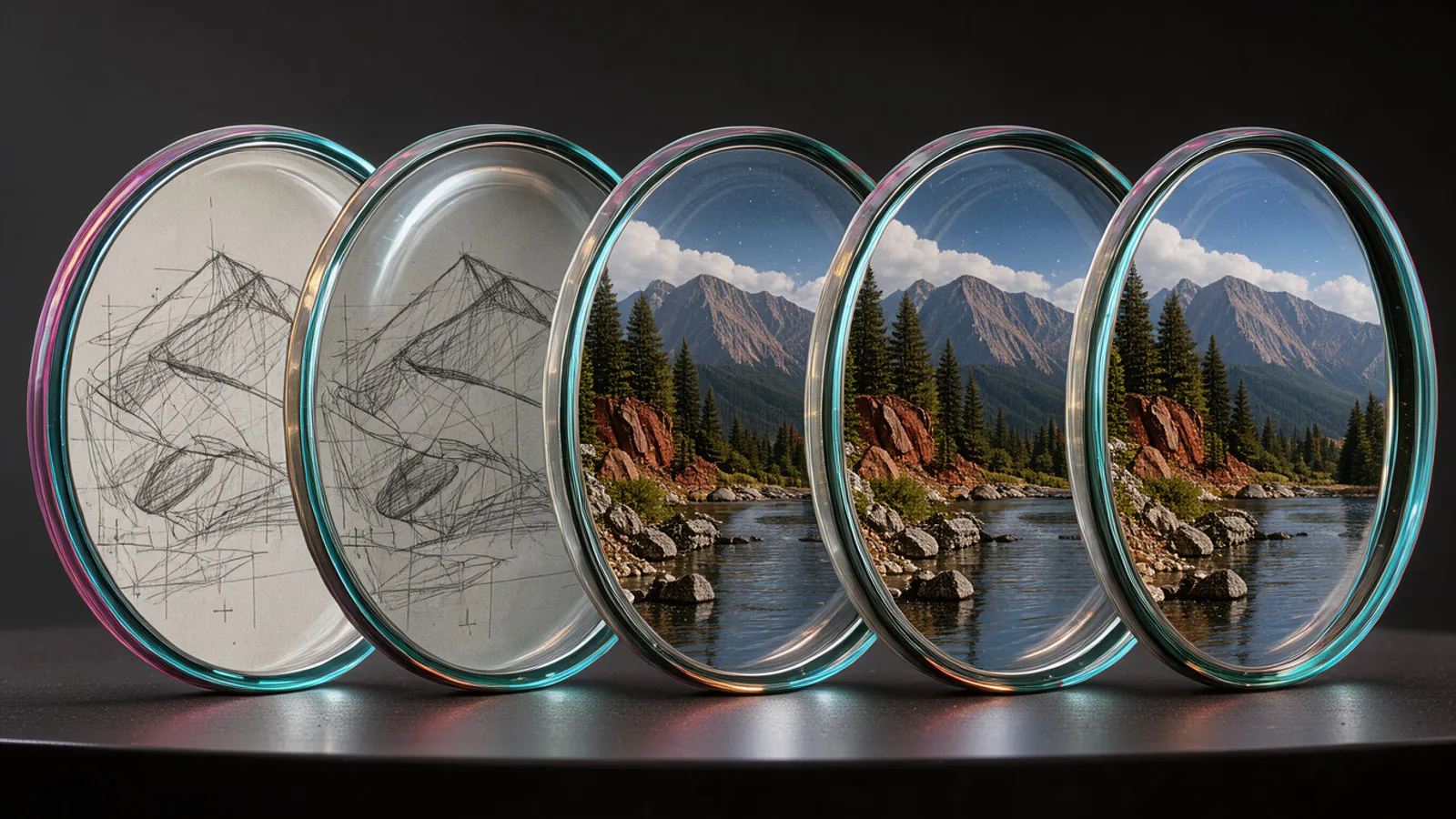 Layered glass panes showing an image sharpening from draft to detail.
The reasoning starts with attention cost, which grows with the square of token count. Linum says latent diffusion models appear to hit an empirical ceiling of 16x16 token compression unless the autoencoder is changed significantly, while pixel-space models (JiT) reached 32x32. Fewer tokens means cheaper attention in both training and inference.
P-JiT follows Linum's earlier JiT-DDT, an encoder-decoder design that Linum says trained 3.6x faster than its prior latent model. The open question for that design was how to split parameters between encoder and decoder. The Decoupled Diffusion Transformer work that inspired it found it optimal to give the encoder 4x more parameters than the decoder. P-JiT avoids the split by going decoder-only.
Pyramid-JiT benchmarks: what Linum claims
Linum reports that P-JiT reaches Linum v2's final FD-DINOv2 score using 11.3x fewer training samples. These are Linum's own numbers, not independent results, and they come from a training-efficiency chart rather than a head-to-head quality test.
| Model | Type | FD-DINOv2 (lower is better) |
|---|---|---|
| Linum v2 | Latent diffusion | 79.9 |
| JiT-DDT | Pixel-space, encoder-decoder | 39.1 |
| P-JiT | Pixel-space, decoder-only | 27.9 |
| Real-vs-real floor | Reference | 25.4 |
Each point scores 30K generations at 256² against 30K in-domain real images. Only four Linum v2 image checkpoints survive, so its curve starts at 117M samples, and lines between checkpoints are interpolated in log-log.
The write-up also lists prompt-following benchmarks in an appendix. Their results are not reproduced here.
FD-DINOv2 measures how close generated images are to a real image distribution. It does not tell you whether an output follows a brief or sells a product. Read it as a signal about training efficiency.
How to use Pyramid-JiT 2B for AI video and static ads
For most marketers, nothing changes today. There is no hosted tool, no API, and no announced output resolution beyond the 256² benchmark setting, and Linum calls this a research checkpoint.
 A creative workbench with product mockups beside a small glowing compute board.
Teams with ML engineers can download the weights and test them for product concepts or style drafts. The Apache 2.0 license is permissive, which makes internal experiments and fine-tuning straightforward to evaluate. Sample quality at ad-ready resolutions is the thing to check first.
Creative teams without that capacity have little to act on yet. The model that could matter for hooks and b-roll is Linum v3, the video model this work feeds, and it has no date. When video models do ship, you can compare them side by side in the AdGraam Playground.
For static ads now, the Creative Generator and our guide to static ads with AI cover production workflows. Another open-weights image release is covered in P-H3-Image.
Why the training cost matters for creative teams
A roughly $20K from-scratch training run, if it holds up, shows that building an image model is no longer limited to large labs. Linum reports the figure itself, and it has not been independently verified.
For brands, the practical effect is indirect. Cheaper training can mean more open models, more fine-tunes on brand-specific product imagery, and lower prices for hosted generation over time. None of that is announced for this model.
Linum's stated goal is to build affordable animation tools. It says top video models such as Seedance are expensive because attention runs over very large token sequences. For its own Linum v2, a 720p, 5 second clip cost 110K tokens, and Linum wants to cut video generation cost by an order of magnitude.
If token counts fall as Linum hopes, per-clip costs for hooks and b-roll could fall too. That depends on Linum v3 shipping and performing, and Linum has given no timeline.
What to watch next
Linum says more research checkpoints are coming on the way to Linum v3. Each one should show whether the pixel-space approach scales beyond 256² benchmarks.
Unknowns right now:
- Output resolution and sample quality at higher resolutions
- Any hosted version or API
- Independent comparisons against other open image models
- A Linum v3 release date
Independent side-by-side tests would show whether the efficiency gains carry into image quality that matters for ads. Until then, treat Pyramid-JiT 2B as a credible research release with open weights, and a data point on training cost, not a production tool.
What people are posting
We’re a 2-person lab researching more efficient architectures for generative image and video. https://t.co/KWV35VifgY Last month, we published Pyramid-JiT, a pixel-space architecture that converged 11x faster than its latent-diffusion counterpart. Today, we're releasing a 2B https://t.co/yXt3Rr7B0L
I don't think most people realize you can train a generative image model from scratch for $21K now. @LinumInc just did that with two people and a new architecture they built.
Key takeaways
- Linum announced Pyramid-JiT 2B, a 2B text-to-image model, on 2026-11-04.
- Linum says it was trained from scratch for roughly $20K; @snowmaker cites $21K.
- Code and weights are published under the Apache 2.0 license on GitHub and Hugging Face.
- Linum reports it matches Linum v2's final FD-DINOv2 in 11.3x fewer training samples, measured at 256² resolution.
- Linum says to treat it as a research artifact, not a full model release.
- Linum describes it as a checkpoint on the way to Linum v3, a video model; no release date is announced.
Compare 200+ AI video and image models side by side
Run Kling, Veo, Sora, Seedance, Flux, Ideogram and Recraft in one Playground, or turn any product URL into ready-to-launch ads.
Frequently asked
What is Pyramid-JiT 2B?
Pyramid-JiT 2B is a 2B text-to-image model from Linum, a 2-person research lab. It uses a decoder-only pixel-space architecture with no VAE. Linum released code and weights on 2026-11-04.
How much did Pyramid-JiT 2B cost to train?
Linum says it was trained from scratch for only about $20K. @snowmaker, an account that reposted the news, put the figure at $21K.
Is Pyramid-JiT 2B free to use?
The weights are free to download under the Apache 2.0 license, which generally permits commercial use. Linum has not announced a hosted app or API, so you would need to run it yourself.
Can I use Pyramid-JiT 2B for commercial ads?
Apache 2.0 is a permissive license, but Linum describes the release as a research artifact. Review output quality and the license terms yourself before relying on it for ads.
Where can I download Pyramid-JiT 2B?
Code is at github.com/Linum-AI/pyramid-jit and weights are at huggingface.co/Linum-AI/pyramid-jit.
Sources
More AI model news & creative guides

HeyGen Video 1 Is Out: Features, Pricing and Access
HeyGen Video 1 is live: text-to-video with picture, dialogue and sound in one pass, a free tier, a $0.02 per second API and a new mobile app. Full details.

Kling 4 Flash Is Out: Features, Pricing and Access
Kling 4.0 Flash is now open to everyone on the Kling AI website and API. See specs, 3 to 20 second 720p clips, plans, pricing and what it means for ads.

PixVerse Depth Map Control: Features and How to Use It
PixVerse Depth Map Control lets you recreate the motion of any video with your own character. See how the workflow runs and what it means for ad creatives.
AI UGC Ads: What They Are, What They Cost and How to Make One
AI UGC ads explained for D2C brands: how they compare with creator UGC on cost and speed, which formats work, the disclosure rules and how to make one.
Hook Rate and Hold Rate: Formulas and Benchmarks for Meta Ads
How to calculate hook rate and hold rate for Facebook and Instagram video ads, what good looks like, how to add them to Ads Manager and what to fix when they drop.
How to Make Static Ads With AI: A Guide for D2C Brands
How to make static ads with AI, step by step: the sizes Meta wants, eight formats worth testing, a brief template and the checks to run before you upload.
Your move
See your product as a winning ad
Turn a product URL into static ads and UGC-style videos, rebuild the competitor ads that already work, and read your Meta data to know what to make next.
AdGraam News DeskAI video and image news
The AdGraam News Desk tracks AI image and video model launches, leaks and rumors from labs, leakers and creators, and checks each claim against its sources. Unconfirmed stories say so, and each page is updated as its story develops.